Airewrite is a great rapid-prototyping layer — but it isn't always the final system. If your accuracy has plateaued after months of prompt engineering, token spend keeps surprising finance, or audit teams now demand deterministic embeddings and traceable retrievals, it's time to plan a migration to RAG, a managed or self-hosted vector DB, and selective fine-tuning.
Below is a field-tested playbook for CTOs and engineering leads already running Airewrite (or similar hosted LLM orchestration). It is pragmatic: vendor names you can call tomorrow, measurable SLOs to keep during cutover, and rollback patterns we've used to cut token spend by 60% without user impact.
When to consider migrating — quick thresholds
- Accuracy plateau after prompt iteration: <2% absolute improvement after three months of SLM testing and prompt A/Bs. Time to inspect retrieval and data quality rather than rewrite prompts.
- Token spend volatility: month-over-month token spend rising >25% with stable traffic. Cost containment often requires switching to embedding + retrieval or a cheaper embedding provider (Vertex AI embeddings or Anthropic embeddings where available).
- Audit/compliance needs: requirement for explainable retrieval (document-level provenance) or retention policies that Airewrite’s hosted flows can’t expose.
- Latency or concurrency limits: P95 latency >1s for synchronous customer UX; or hitting soft throttles for peak-times during batch jobs.
If one or more apply, start the migration project. The rest of the playbook assumes you keep Airewrite in production during cutover.
Migration checklist — step by step
- Metrics & data audit (2–4 weeks)
- Catalog inputs (documents, knowledge bases, logs) and outputs (answers, classifications). Use Snowflake/Databricks + dbt to version the datasets and create an evidence bundle for each query.
- Measure baseline SLOs: latency P95, token cost per request, answer precision/recall against a test corpus. You’ll use these for canary and rollback triggers.
- Run data quality checks with Great Expectations and ensure your feature store (Feast/Tecton) can serve metadata for retrievals.
- Add a vector layer (3–6 weeks)
- Choose: Pinecone (managed, low ops), Chroma (embeddings-first, flexible hosting), Weaviate (graph-enabled), or pgvector (self-hosted, lowest infra cost). Pinecone is our go-to when uptime and SLA matter; pgvector when you want predictable infra spend.
- Build an embeddings pipeline. Start by mirroring the Airewrite context into a vector index (batch-upsert). Use Vertex AI embeddings or Anthropic embeddings as an alternative to OpenAI if you need enterprise pricing or EU residency.
- Validate retrieval quality: run similarity-search vs Airewrite’s original context window for the same queries. Compare answer parity and latency.
- Swap inference or embeddings selectively (2–4 weeks)
- If embeddings are the bottleneck, swap providers first (e.g., OpenAI embeddings -> Vertex AI embeddings). If generation is the issue, test inference on Vertex AI or Anthropic for latency and cost.
- Keep a consistent embedding model across index and query-time to avoid drift.
- Fine-tune only where RAG fails (2–6 weeks)
- Prefer retrieval + prompt engineering first. If persistent hallucinations or domain-specific phrasing remain, fine-tune a smaller model (LoRA or curated fine-tune) on Vertex AI or SageMaker.
- Use MLflow for model registry and Seldon for canary serving. Maintain a human-labeled holdout set to track precision gains.
- Monitoring, governance, and pipeline hardening
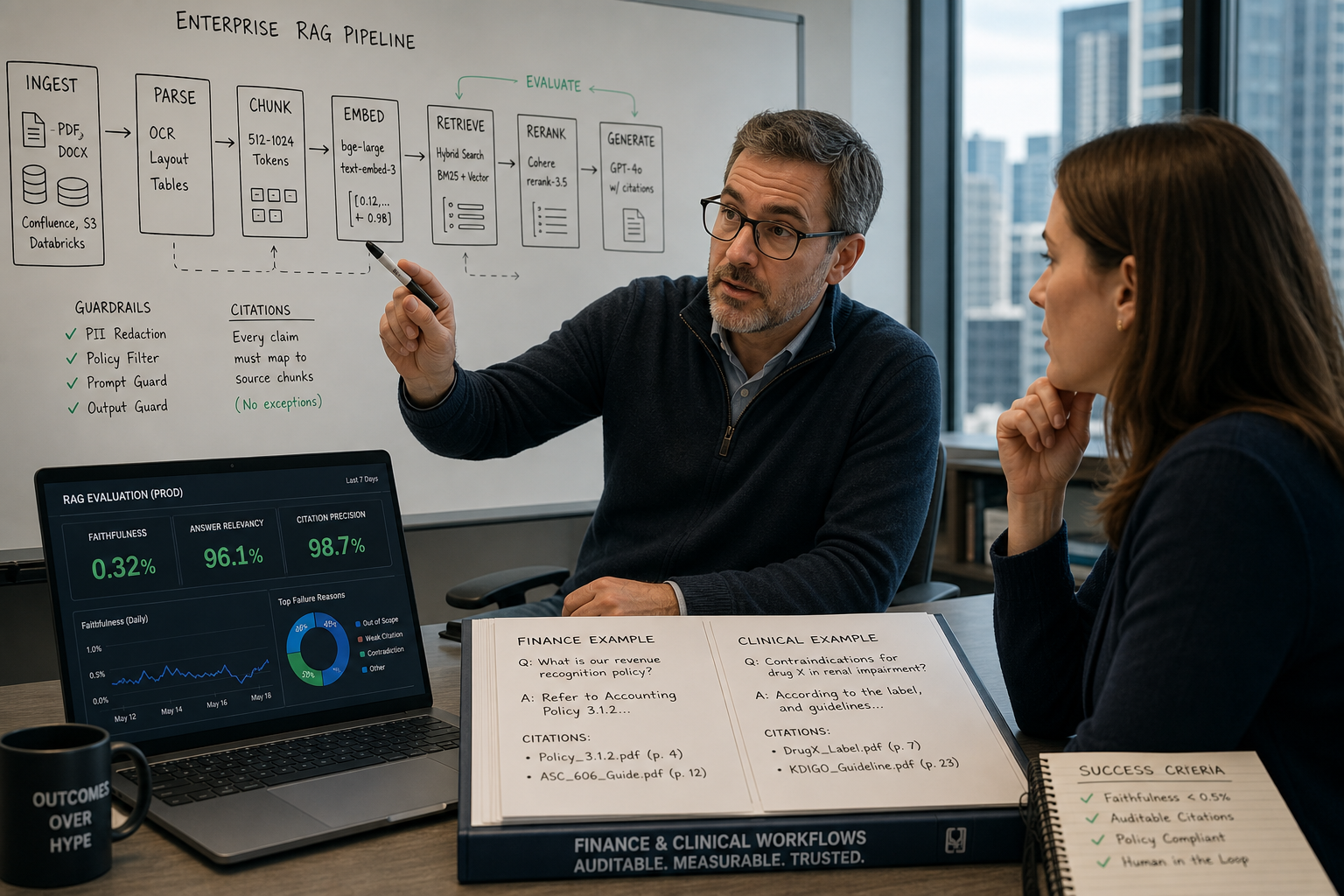
- Deploy Arize for drift and explanation monitoring. Log retrieval provenance and embed hashes to support audits. Use Databricks/Snowflake + dbt to store evidence bundles for every decision.
Architecture: before vs after (cutover plan) 🧭
Below is a simplified ASCII diagram of the common migration path — keep Airewrite in the loop until parity is proven.
# Current (fast prototype)
Client -> Airewrite (prompts + LLM) -> LLM -> Response

# Target (RAG + vector DB + optional fine-tune)
Client -> API Gateway -> Router
  -> Airewrite (shadow/write) ----------------------------> LLM A (current)
  -> Vector DB (Pinecone/Chroma/pgvector) <--- Embedding pipeline
  -> RAG Service -> LLM B (Vertex/Anthropic or fine-tuned SageMaker)
  -> Response

# Cutover flow
1) Shadow traffic to RAG (no user impact)
2) Canary 1% production traffic with response parity checks
3) Gradual ramp with automated rollback on divergence or SLO breach
Keeping prompt-level SLOs during cutover
SLOs you must track per prompt: answer correctness (human or automated classifier), latency P95, and token cost per request.
- Shadowing: send every production request to both Airewrite and your RAG path. Store both responses and calculate a similarity score. No user sees the RAG response during this phase.
- Canary with feature flags: roll 1–5% of traffic to RAG with real users. Require atomic checks: if (response_similarity < threshold OR hallucination_detected) then route request back to Airewrite and increment rollback counter.
- Automated rollback conditions: set explicit thresholds (e.g., similarity drop >8% vs baseline, latency P95 increase >200ms, token cost per request >20% higher). If triggers exceed X in 1 hour, rollback traffic to Airewrite instantly.
Concrete rollback pattern that saved 60% token spend: We shadowed a document-Q&A workload, trimmed returned contexts with vector similarity, and served the RAG response only after a parity classifier passed. During canary, we used a weighted traffic split and an automated parity check; when parity held, we moved 10% → 50% → 100%. The trimmed-context approach cut token consumption by 60% and did not change end-user answers because the retrieval step ensured relevant passages were returned.
Fine-tuning: when and how
- When: persistent domain-specific failure cases after RAG and prompt engineering (legalese in contracts, domain abbreviations, or proprietary taxonomies).
- How: prefer parameter-efficient fine-tuning (LoRA) first. Host the tuned model on Vertex AI or SageMaker. Register artifacts in MLflow, run canaries through Seldon, and monitor with Arize.
- Rollback: keep the previous model hot and ready; route only a small percentage to the fine-tuned model until the holdout set shows a statistically significant lift.
Choosing a vector DB — quick decision matrix
| Use case | Suggested vendor | Why |
|---|---|---|
| Managed, SLA, multi-region | Pinecone | Low ops, vector indexes + metadata, built-in metrics |
| Self-host, Postgres-first | pgvector | Predictable infra cost, SQL-based ops |
| Developer-first, flexible | Chroma | Easy local dev, cloud options |
| Graph needs, hybrid search | Weaviate | Vector + semantic graph features |
Cost and governance notes
- Embeddings are where you usually save most of the tokens: smaller context windows + retrieval vs giant prompt stuffing. Combine a cheaper embedding provider (Vertex) with Pinecone or pgvector to shrink inference tokens.
- For compliance, persist an evidence bundle per request (input, retrieved doc IDs, embeddings hash, final prompt) in Snowflake or Databricks so audits have a reproducible trail.
Final checklist before cutover
- Baseline SLOs captured and stored
- Shadow traffic running for 7–14 days with parity > threshold
- Canary automation and rollback rules in place (latency, similarity, hallucination)
- Monitoring hooked (Arize, Seldon metrics, Databricks/Snowflake logs)
- Business sign-off on cost model and retention policy
Conclusion & CTA
Need help with Airewrite migration playbook? Book a free strategy call with Niche.dev.
Suggested Internal Links
- /success-stories/ai-rewrite-dev/
- /blog/ai-receptionist-salesforce-integration/