Take a stance (2 sentences)
If your legal or compliance team insists on auditable vectors and tight data residency, do not blindly "build" your RAG layer without a TCO model — off-the-shelf vector stores plus managed LLMs typically win for mid-market production. DIY is defensible only when you have the engineering runway to own availability, exportability, and forensic logging for 36 months.
What an apples-to-apples 3-year TCO must include
If you compare build vs buy, include these line-items — anything else is false precision:
- Infrastructure (k8s, GPU/CPU hosts, load balancers) and ops (SRE FTEs). Example: one senior SRE + one ML engineer at market rates is a recurring cost you can't ignore.
- Vector store costs: storage, indexing CPU, query IOPS, and backup/replication. If you run Milvus on your own, count the node hours; managed Pinecone/Weaviate bill by pods and query throughput.
- Embeddings pipeline: cost per embed (batch vs streaming), orchestration (Airflow/Cloud Tasks), and storage of original documents.
- LLM inference: managed provider per-token or per-request costs, plus network egress and SLA credits.
- Monitoring, drift detection, and audit logs: model/embedding drift, schema drift, and vector lineage — tools like Arize or Datadog and log-retention fees.
- Incident response SLA: pager rotations, runbooks, postmortems, and contractual credits.
Example workload (used through the post): mid-market support RAG with 1M queries/month (~12M/yr), 50M stored vectors, 300k new vectors/month. Use this baseline to compare options.
Numeric checkpoint: 3-year query volume = 36M, vectors stored = 50M, ingestion events = 10.8M.
Pinecone vs Weaviate vs Milvus — apples-to-apples comparison
Short recommendation: for most mid-market teams buy Pinecone or a managed Weaviate offer; build Milvus only if you must control every piece of infra and you have a 2–3 person SRE team.
| Feature | Pinecone (managed) | Weaviate (managed/self-host) | Milvus (self-hosted) |
|---|---|---|---|
| Managed offering | Yes (fully) | Yes / self-hosted | Primarily self-hosted |
| Typical SLA | 99.95% (enterprise) | 99.9% managed | depends on you |
| Audit & export | Enterprise audit logs + export | Managed offers audit, OSS varies | You control logs/export |
| Scaling | Auto-scaling pods | Pod autoscale or cloud-managed | Manual cluster ops |
| Latency (typical P95) | 30–120ms per vector query | 50–150ms | 60–200ms |
| Best for | Fast time-to-prod, predictable billing | Flexibility, hybrid deployments, data residency | Full control, cost optimization at scale |
Numeric checkpoint: expect P95 latencies in the 30–150ms range; if SLA-bound queries exceed 100ms, include latency credits in the TCO.
Managed LLM SLA and pricing realities: OpenAI, Anthropic, Vertex AI
Managed LLMs reduce ops but add contractual complexity. The critical cost levers are per-request cost, cold-start latency (affects user experience), and SLA/egress terms.
- OpenAI: best for raw throughput and rapid model improvements; watch for egress and model-deprecation timelines. Numeric example: if average LLM call costs $0.01–$0.05 per request (prompt + response), 1M requests/month is $10k–$50k/month for inference alone.
- Anthropic: enterprise-focused SLAs and guardrails; often priced similarly to OpenAI but with different content controls.
- Vertex AI (Google): better for strict GCP-native data residency and VPC-SC setups; can drop egress between Google services but watch network egress to other clouds.
SLA traps: many vendors offer a 99.9% SLA but exclude "scheduled maintenance" or throttle heavy workloads without clear re-credit rules. Ask for explicit latency SLAs (P95/P99), not just uptime.
Numeric checkpoint: add 10–25% headroom for unexpected peak costs and model-version migrations over 36 months.
Operational controls: audit, data residency, drift monitoring
If compliance requires auditable vectors, you need exportable, queryable audit trails: who hashed or created the vector, original document ID, embedding model version, and timestamp. This is where buy vs build diverges:
- Off-the-shelf stores (Pinecone/managed Weaviate) provide enterprise audit logs, retention policies, RBAC, and easier export into object storage — reduces legal exposure and SRE time.
- Self-hosted Milvus can provide the same, but you must implement immutable append-only logs, secure key management (BYOK), and long-term retention to satisfy auditors.
Monitoring stack: use ML monitoring (Arize or Seldon + custom telemetry), feature drift tools (Feast/Tecton), and data-quality checks (Great Expectations). Numeric checkpoint: plan for 2–4% of annual infra + SaaS spend on monitoring and logging retention.
Sample 3-year TCO (illustrative example)
Assumptions (example workload): 1M queries/month; 50M vectors stored; 300k vectors added monthly.
Line items (yearly, approximate — illustrative):
- Managed vector DB (Pinecone enterprise): $60k–$120k/year (storage, query throughput, backups)
- Embedding pipeline (managed embeddings via OpenAI + orchestration): $24k–$72k/year (embedding cost + cloud run)
- LLM inference (OpenAI/Anthropic): $120k–$600k/year depending on model tier and response length
- Monitoring & logs (Arize/Datadog/ELK): $30k–$90k/year
- SRE & ML engineering (1.5 FTE effective on-call): $200k–$300k/year fully loaded
- Misc (network egress, backups, incident credits): $10k–$50k/year
3-year totals (buy managed stack): ~$1.2M–$3.3M
If you build and self-host Milvus + self-managed embeddings + self-hosted LLM inference on GPUs, you trade SaaS fees for capital and people costs: initial infra + 2 SRE/ML engineers + GPU ops could put 3-year costs in a similar or higher band unless your QPS and vector volume are 3–5× this baseline.
Numeric takeaway: for our example workload, managed buys typically win on TCO and time-to-compliance for mid-market unless you expect queries or vectors to scale >3x within 6–12 months and you have bench depth in ops.
Contract clauses and SLA negotiation checklist
Don't sign the order form until these are explicit in the contract:
- Data ownership & exportability: regular full-export API at no charge, frequency documented.
- Audit logs: retention window, granularity (per-query fields), and proof of immutability.
- Egress fees: explicit caps and predictable pricing for cross-region transfer.
- Latency SLAs: P95/P99 with dollar credits, not only uptime.
- Model-deprecation policy: notice windows and migration support.
- Security & compliance: SOC2/HIPAA attestations, BYOK, CMEK, and VPC connectivity.
- Support & incident runbooks: RTO/RPO commitments and a named escalation path.
Numeric checkpoint: insist on defined credit formulas (e.g., 5% credit per 1% below SLA) and run a quick model of likely credits vs. lost revenue to see if credits are meaningful.
Implementation decision flow (short)
- Compliance-first (auditable vectors, residency): prefer managed Weaviate (cloud-provider specific) or Pinecone enterprise — you get logs, export, and fewer unknowns.
- Cost-first & scale >3x in 12 months: model self-hosted Milvus but only if you staff 2 SREs and own GPU ops.
- Speed-to-market: managed Pinecone + OpenAI/Anthropic + Arize for monitoring.
Example architecture (buy):
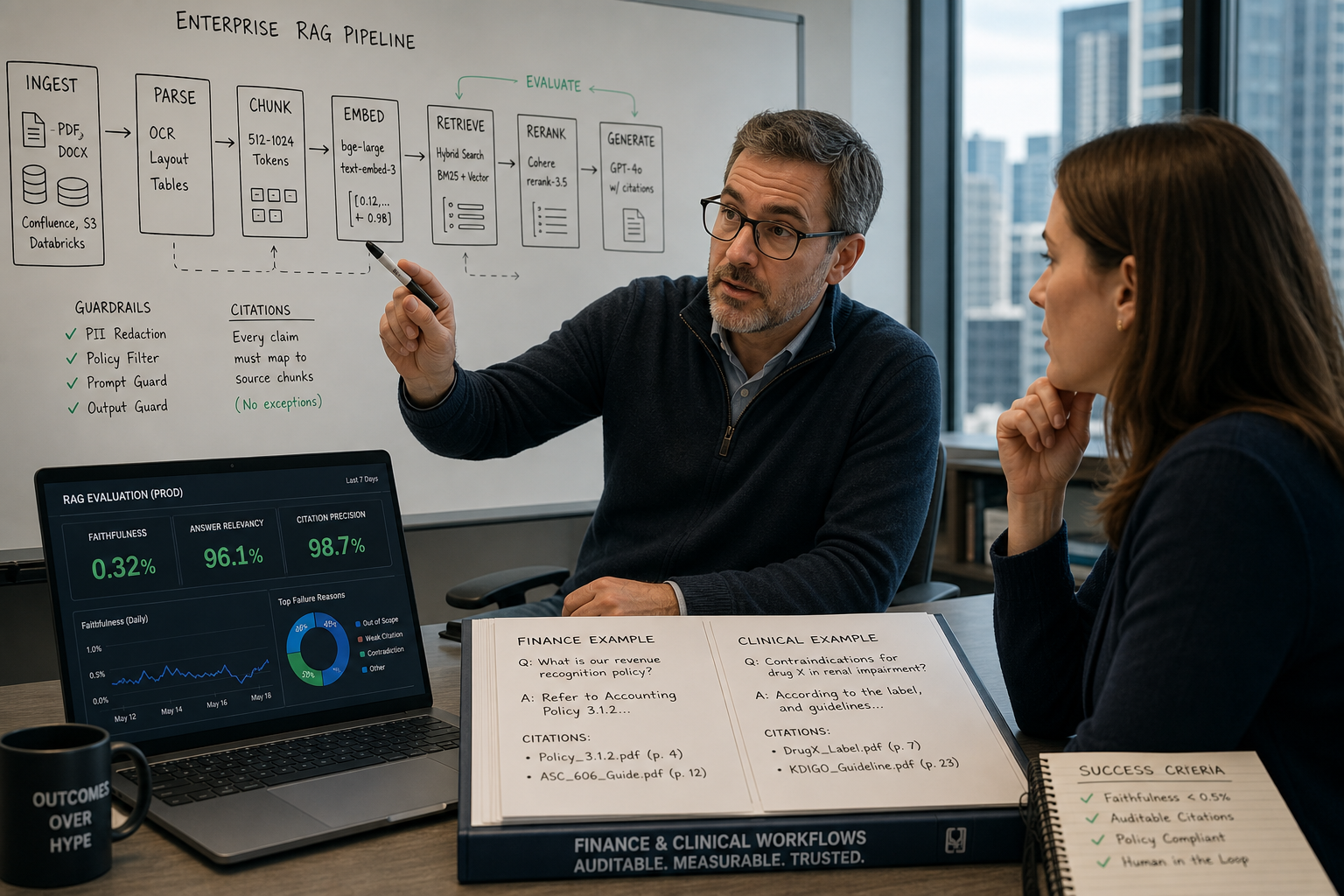
[Document Store] -> [ETL / OCR / OCR pipeline (dbt, Airflow)] -> [Embedding Service (OpenAI embeddings)] -> [Managed Vector DB (Pinecone)] -> [Retriever] -> [LLM (OpenAI/Anthropic/Vertex)] -> [App/server]

Example architecture (build):
[Document Store] -> [ETL] -> [In-house embedding service (hosts on GCP GPUs)] -> [Milvus cluster on k8s] -> [Retriever on k8s + Redis cache] -> [Self-hosted LLM infra (GPUs)] -> [App/server]
Closing guidance and measurable outcomes
For the mid-market example above, the decision usually comes down to two numbers: (1) full-time equivalent ops cost to hit 99.9%+ production SLAs and (2) cost per 1M queries including LLM inference. If your legal team needs auditable vectors and you can't accept multi-week export times, buy managed and negotiate audit/export clauses. If you need complete control and can staff SREs, build — but only after modeling 36 months of people+infra costs.
We routinely map RAG projects into measurable outcomes: dollars saved, hours returned, errors avoided, claims recovered. For example, our Document Intelligence engagements have cut invoice processing from 4 hours/day to 15 minutes at 99.2% extraction accuracy — tie every RAG decision to the metric it moves.
Conclusion & CTA
Need help with build vs buy a RAG layer? Book a free strategy call with Niche.dev.
Suggested Internal Links
- How to Audit Your Data Before Starting an AI Project - https://synthetic://cmouha5dg0000mh0fg9jxfbt2/indexed-content/niche-dev/data-audit-ai.md
- The Role of MLOps in Scalable AI Systems - https://synthetic://cmouha5dg0000mh0fg9jxfbt2/indexed-content/niche-dev/mlops-enterprise.md
- Enterprise AI Strategy: How to Successfully Integrate AI Into Your Business Workflow - https://synthetic://cmouha5dg0000mh0fg9jxfbt2/indexed-content/niche-dev/enterprise-ai-strategy.md