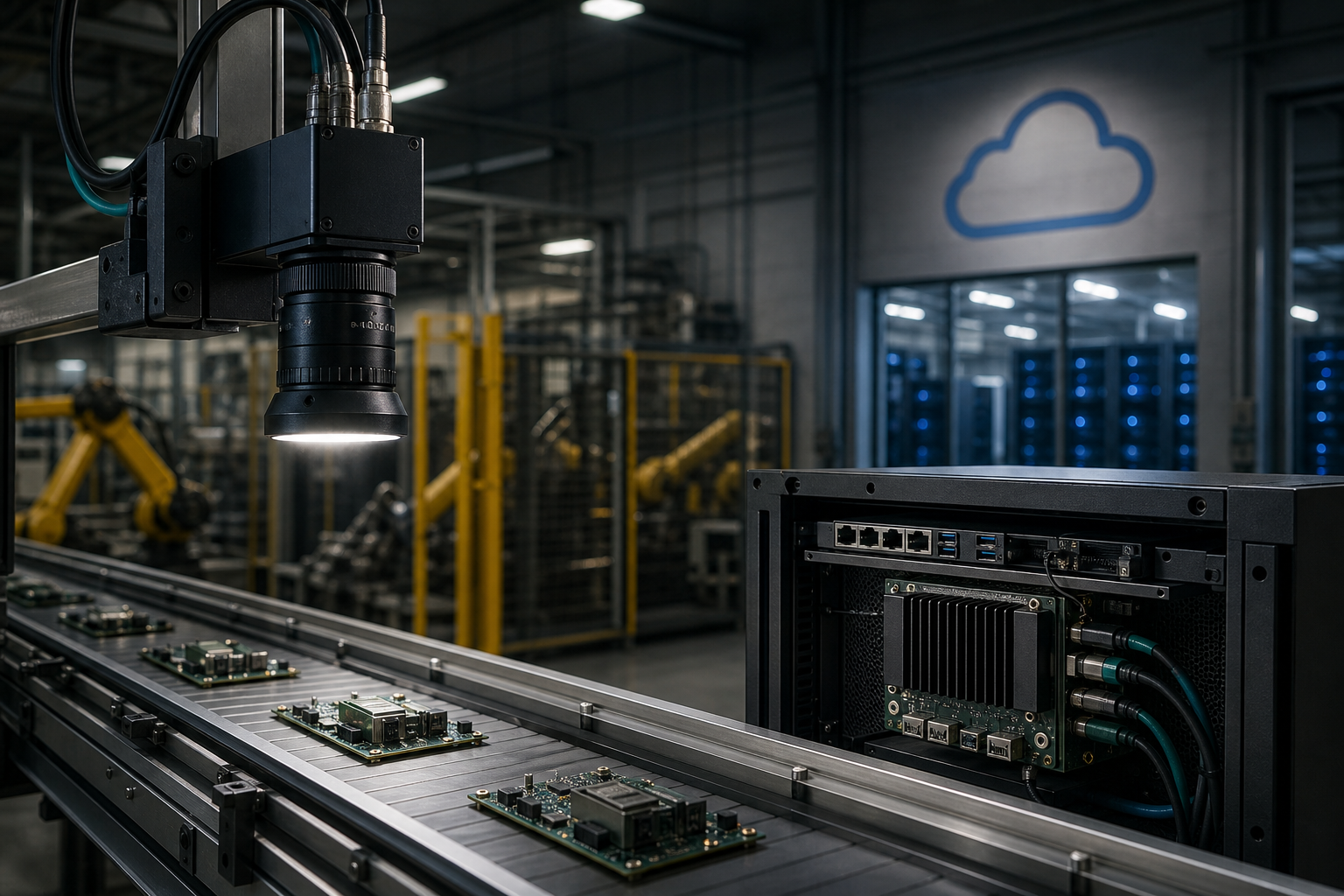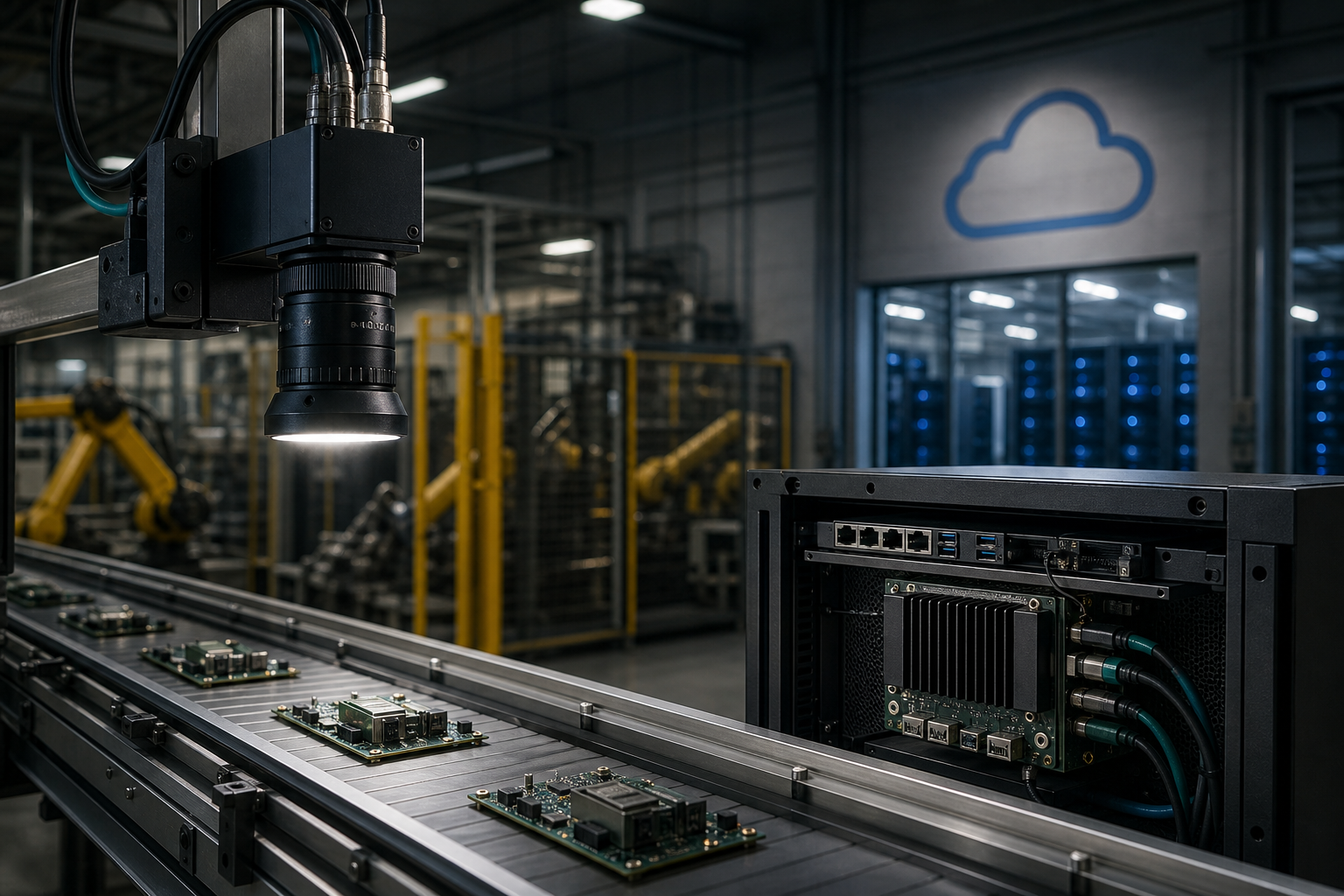
Don't pick edge or cloud on ideology—pick it for latency, throughput, and who pays the power bill. If your camera needs sub-50ms feedback, buy a box and put it on the line; if you need occasional high-quality batch scoring and a central MLOps pipeline, favor cloud. This is a CFO-facing playbook: concrete decision triggers, vendor tradeoffs, ROI thresholds, and a 6-point pilot checklist.
Decision matrix: three variables that should decide your architecture
Make the decision by answering three questions with numbers, not gut feel: latency requirement, per-camera throughput, and operational cost owner (capital vs OPEX).
- Latency: if you need action within a human/PLC reaction window (≤50 ms) put inference at the edge (Jetson/Coral). NVIDIA Jetson (Xavier/Orin variants) targets sub-50ms for 1080p single-frame detection; Coral is good for simple models under 60ms on proof-of-concept boards.
- Throughput: cameras that stream dozens of frames per second multiply cloud cost quickly. If a single camera sends 30 FPS and you process every frame, cloud inference bill and egress dominate. Batch or sample before cloud to reduce bill.
- Who pays power and network: if the factory pays electricity and you control racks, CAPEX (edge boxes) often wins at scale; if you prefer OPEX and zero-device maintenance, cloud wins for low-frame-rate or intermittent workloads.
Quick thresholds (practical rules):
- Real-time control/PLC feedback: edge (Jetson/Orin).
- Triage/analytics where a 1–10s delay is acceptable and model complexity/accuracy benefits from large GPUs: cloud (Vertex AI Vision / SageMaker) or hybrid.
- Proof-of-concept with minimal spend: Google Coral or Jetson Nano for on-site demos.
Table: quick comparison
| Requirement | Edge (Jetson/Coral) | Cloud (AWS Panorama / Vertex/SageMaker) |
|---|---|---|
| Latency | <50ms achievable | 100ms–seconds (incl. network) |
| Unit cost (device) | $150–$1,200 (one-time) | $0 setup; pay per inference/egress |
| Scale ops | Device fleet management required | Managed fleet / centralized MLOps |
| Best when | Real-time feedback, high-frame-rate | High accuracy batch scoring, heavy models |
Vendor tradeoffs: Jetson, AWS Panorama, Google Coral 🧭
NVIDIA Jetson (Xavier NX / Orin NX)
- Strengths: raw on-device GPU for modern CNNs and transformer-based vision models; easy to run optimized TensorRT pipelines; consistent sub-50ms single-frame inference for standard detection models.
- Costs: higher unit CAPEX and a small continuous power draw (~10–30W depending on model). Device management (OTA, health checks) is your responsibility; we use MLflow + Seldon/Arize in production for model tracking and observability.
- When to pick: line-side defect detection, safety interlocks, cycle-time critical tasks.
AWS Panorama
- Strengths: managed appliance + fleet service; integrates with AWS cloud for model training, model registry, and centralized monitoring. Good when you want a managed hybrid path and single-vendor support.
- Costs: OPEX for service + network. Good for fleets where you don’t want to operate your own device management stack.
- When to pick: centralized operations with a preference for AWS and moderate latency needs.
Google Coral
- Strengths: lowest-cost proof-of-concept hardware (Coral Dev Board / USB accelerators), low power consumption, easy to deploy for quantized models.
- Limits: smaller models only (Edge TPU constraints), less headroom for future model complexity.
- When to pick: cheap PoC, fast iteration, or extremely low-power scenarios.
Tradeoff summary: Jetson for performance and long-term headroom; Panorama for managed operations and hybrid pipelines; Coral for low-cost PoC.
CFO playbook: a simple cost model and ROI thresholds
You don't need a black box — use three lines in a spreadsheet: device CAPEX amortized, cloud OPEX per inference (including egress), and expected yield uplift per camera.
Inputs (example assumptions for modeling):
- Device CAPEX (Jetson Xavier NX as example): $399 one-time.
- Device life: 4 years → monthly amortized ≈ $8.30.
- Power and maintenance: $6–$12/month (power, network port, patching).
- Cloud inference cost: $0.0005–$0.01 per image (model & instance dependent). Use conservative $0.002 for midweight models.
- Network egress: assume $0.05/GB — multiply by average bytes/image (e.g., 0.2 MB compressed) → ~$0.00001/image.
Worked example — 24/7 camera, sample 1 FPS (86,400 images/day → 2.6M/month):
- Cloud-only inference cost ≈ 2.6M * $0.002 = $5,200/month (plus egress ~$26/month).
- Edge (amortized + ops) ≈ $8.30 + $9 = $17.30/month per device. Even if you batch and send 5% of images to cloud for review, cloud cost drops to ~$260/month.
Break-even rule of thumb:
- If monthly cloud inference for one camera > monthly edge TCO (amortized CAPEX + ops), buy the device.
- If you can reduce processing to <5–10% of frames with smart sampling, cloud becomes attractive.
Tie to outcomes: a 1% yield lift on a production line making $1M/month is $10k/month — paying $5,200 for cloud to capture that lift can be justified; but if the lift is only $500/month, edge CAPEX wins.
Architecture patterns (ASCII) — three practical patterns
Inline low-latency (edge inference)
[Camera] -> [Jetson/Coral] -> [PLC/Actuator] (local alerts/logs) -> periodic batches -> [Central MLOps/DB]
Hybrid (edge filter + cloud heavy models)
[Camera] -> [Edge pre-filter (Jetson)] -> low-bandwidth samples -> [AWS Panorama / Vertex AI] -> [Ops dashboard (Tableau/Power BI)]
Cloud-first (analytics & slow feedback)
[Camera] -> secure stream -> [Edge encoder] -> [Cloud inference (Vertex/SageMaker)] -> [Audit + retrain pipeline (Databricks + MLflow)]
6-point pilot checklist (practical, no-fluff)
- Define the KPI in dollars or hours (e.g., reduce scrap by X kg/month = $Y). If you can’t map it to money, don’t pilot.
- Measure baseline telemetry for 2–4 weeks — frame rates, compressions, network uptime, and power availability.
- Choose sampling strategy: process every frame, n-th frame, or only event-driven frames. Model cost scales linearly with frames processed.
- Pick hardware for the pilot: Coral for <$500 PoC, Jetson for representative latency tests, AWS Panorama if you want managed hybrid quickly.
- Budget for device management: OTA, logging, and health checks. No device equals eventual tech debt.
- Define retraining cadence and data capture policy (store false positives/negatives). Wire this to your MLOps stack (Databricks, MLflow, Arize) before scaling.
A few gotchas we've seen
- Processing 30 FPS without pre-filtering is a billing mistake — sample first. We’ve seen prototypes rack up >$10k/month in cloud inference before teams added sampling.
- Ignoring power and cooling: Jetson-class devices draw real watts; include that in OPEX.
- No model observability: if you can’t measure drift you’ll pay for rework. Use Arize or Seldon to track performance.
Near-term wins: safety/PPE vision at the edge returned measurable incident reductions in deployments we've shipped; OCR and document workflows moved to hybrid cloud for heavy models and edge prefiltering when needed.
Conclusion & CTA
Edge vs cloud is a question of measurable tradeoffs, not creed: latency, throughput, and who pays the power bill. Use the spreadsheet rules above, run the 6-point pilot, and choose Jetson for sub-50ms needs, Panorama for managed hybrid fleets, or Coral for low-cost proofs of concept. Tie your choice to dollars saved or hours returned before you buy and instrument model observability from day one.
Need help with edge vs cloud computer vision? Book a free strategy call with Niche.dev.
Suggested Internal Links
- Enterprise AI Strategy: How to Successfully Integrate AI Into Your Business Workflow (synthetic://cmouha5dg0000mh0fg9jxfbt2/indexed-content/niche-dev/enterprise-ai-strategy.md)
- The Role of MLOps in Scalable AI Systems (synthetic://cmouha5dg0000mh0fg9jxfbt2/indexed-content/niche-dev/mlops-enterprise.md)
- How to Audit Your Data Before Starting an AI Project (synthetic://cmouha5dg0000mh0fg9jxfbt2/indexed-content/niche-dev/data-audit-ai.md)
- OCR invoice processing success story (synthetic://cmouha5dg0000mh0fg9jxfbt2/indexed-content/niche-dev/ )