Take a position (2–3 sentences)
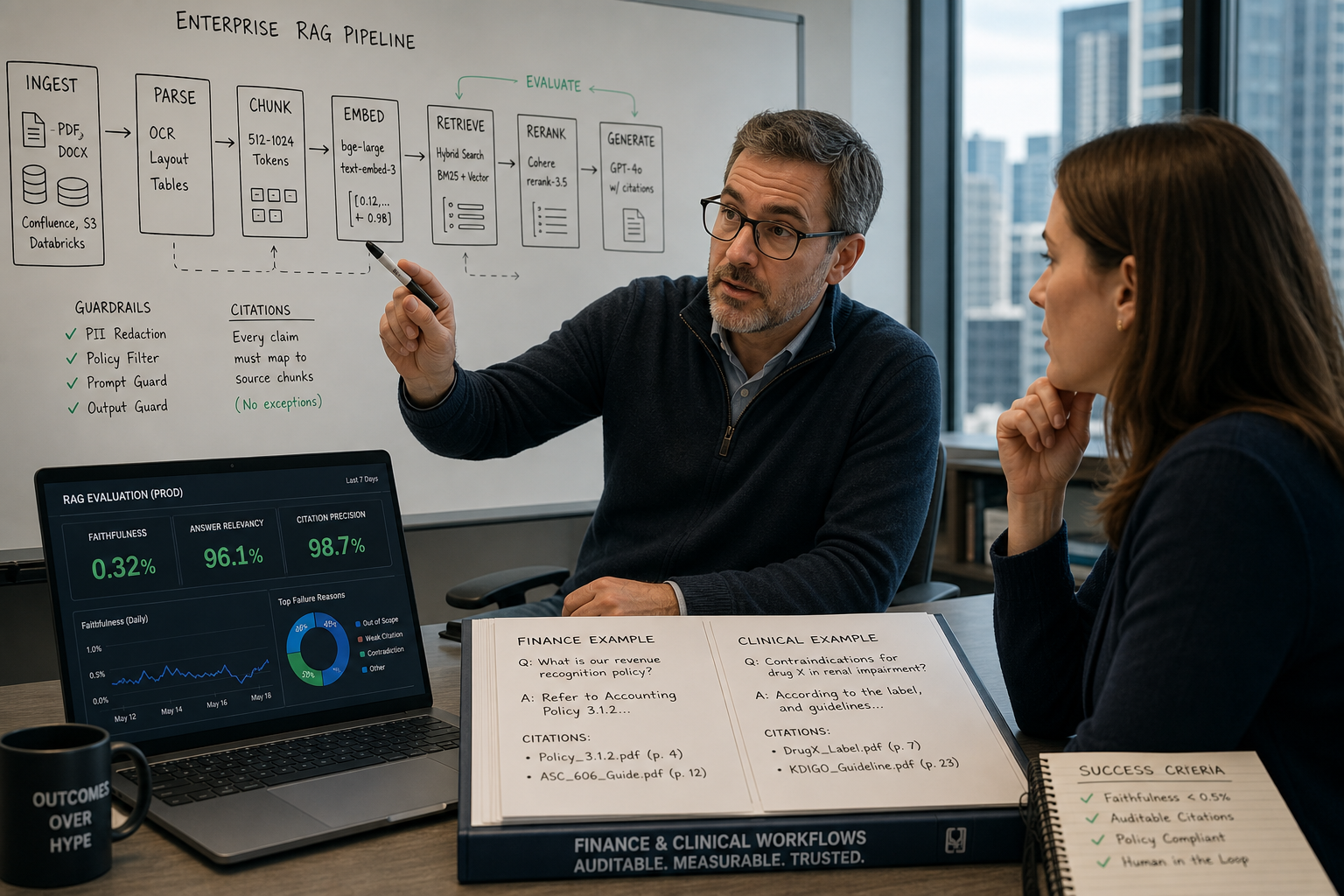
RAG prototypes without measurable SLOs, cost allocation, and a kill‑switch are financial time bombs. If you expect a pilot to survive beyond demo day, you need SLA-style latency and accuracy SLOs, token-and-vector budgeting, autoscaling knobs, and hard safety fences that actually stop bill shock.
What to measure first — concrete SLOs that matter
Stop defining SLOs as "accurate enough". Ship these three baseline SLOs and make them non-negotiable:
- Latency SLOs (observability + enforcement)
- p50, p95, p99 for the full RAG request (vector lookup + embedding + model). Target: p95 ≤ 1.5s for internal agents, ≤ 3s for customer-facing chat — set per use case.
- Measure with Arize, Prometheus + Grafana, or Datadog tracing; tag traces with model type and vector-store latency.
- Accuracy / faithfulness SLOs
- Define a test-set scoring method (exact-match, F1, or human-verified hallucination rate). Example: hallucination rate ≤ 5% on a 200-query audit.
- Run daily evaluation jobs with Great Expectations + a small golden dataset stored in Snowflake or S3.
- Cost SLOs (budget + per-call cost)
- Per-request token budget and vector-query budget. Example enforcement: deny or degrade responses when expected cost > $0.06/request (your target may differ).
Each SLO gets an error budget. When the error budget is exhausted, an automated escalation should occur: switch model to cheaper option, enter degraded mode, or flip a kill‑switch.
Cost controls: token metering, vector-store budgeting, and allocation
LLM spend isn't mysterious — you can meter it.
- Token metering
- Instrument clients to record prompt+completion tokens. Store per-API-call stats in time-series (InfluxDB/Prometheus) and in BigQuery/Snowflake for chargeback.
- Enforce per-API-key token caps in middleware: reject calls or downgrade model if monthly token budget exceeded.
- Vector-store budgeting (Pinecone, Weaviate, pgvector)
- Track vector-store costs: index size (GB), replica count, and query units. Pinecone and Weaviate provide metrics; map those to dollars per GB and per-query.
- Use TTL policies for ephemeral indices. Move archive vectors to cheaper blob storage (S3 + embeddings) and only keep hot index for active tenants.
- Chargeback and allocation
- Tag all requests with tenant/team and push costs to a billing dataset. Use dbt models to compute per-tenant monthly LLM + vector-store cost.
Example cost scenario (illustrative): assume 100k queries/month, average 700 tokens/request, model cost ~$0.03 / 1k tokens => model spend ≈ $2,100/month. Add vector-store and embedding costs and you can easily double that. Build alarms around both the token spend and vector-store egress.
Autoscaling knobs and degraded modes (what to change when error budget burns) 🛠️
Autoscaling here is about controlling cost and preserving SLOs, not chasing zero latency.
- Concurrency limits
- Set a per-service concurrency cap (Cloud Run, Kubernetes HPA with custom metrics). Example: cap concurrency so that model calls don't queue and push p95 beyond SLO.
- Autoscaling rules
- Scale on useful metrics: model in-flight requests, vector-store QPS, and tokens/sec. Datapoints: CPU/memory for embedding service, external metrics for model QPS.
- Degraded-mode responses
- Tier 1 (soft): switch live model from LLM-XX-large to LLM-XX-small, reduce max tokens.
- Tier 2 (hard): return cached answer or a formatted "we're throttled" response pointing users to a slower async flow.
- Implementation pattern
- Implement a centralized policy engine (flagged by tenant) that decides model, max_tokens, and whether to call vector store. Use feature flags (LaunchDarkly) or a config service.
Kill‑switches that actually stop bill shock (and how to implement them)
A kill‑switch must be automatic and auditable.
- Budget-based kill-switch
- Cloud billing alert triggers a webhook to your ops service. That service flips a tenant-level flag to "degraded" and throttles requests.
- Token/Request circuit breaker
- Maintain a rolling counter in Redis per-tenant: tokens_used_last_30d. If tokens_used > budget, set tenant state to READ_ONLY or REDUCED.
- Hard rate limits at the edge
- API Gateway (GCP Endpoints / AWS API Gateway / Kong) enforces per-API-key QPS and burst limits. That prevents runaway parallelism.
- Fail-safe degraded responses
- When kill-switch fires, return a deterministic fallback: cached answer, small extractive snippet, or an offer to submit a ticket.
Sample middleware pseudocode (Node/Express):
// on each request
const tokensNeeded = estimateTokens(req);
if (redis.getCounter(tenant) + tokensNeeded > tenantBudget) {
  res.status(429).json({ mode: 'degraded', message: 'Quota exceeded — using cached answer.' });
  return;
}
redis.increment(tenant, tokensNeeded);
// continue
Observability and alerting: what the ops team needs on their dashboard 📊
SLO dashboards should include:
- Real-time p95 latency for full request and subcalls (embedding, vector query, generation).
- Model cost per minute and per-tenant token consumption.
- Vector-store QPS, read/write latency, index sizes.
- SLO burn rate and error budget remaining.
- Billing alerts with automated remediation playbooks (e.g., downgrade model, limit QPS).
Use Datadog/APM or Grafana + Prometheus for low-latency signals, Snowflake/BigQuery for monthly chargeback reports, and Arize/Seldon for model behavior drift.
Small decision table: rate-limit strategies
| Strategy | When to use | Pros | Cons |
|---|---|---|---|
| API Gateway rate limits | External public APIs | Simple, enforced at edge | Hard to budget per-token costs |
| Token-metering + middleware | Per-tenant chargeback | Accurate cost control | Requires instrumentation across stack |
| Redis circuit breaker | Fast, cross-service state | Immediate enforcement | Needs well-tuned TTLs |
| Cloud billing alarms | Account-level budge | Direct link to billing | Slower (minutes) latency |
Architecture sketch (minimal, deployable)
Client -> API Gateway (rate-limit) -> Auth + Quota middleware -> Router
  Router -> Embedding Service (autoscaled) -> Vector Store (Pinecone/Weaviate/pgvector)
  Router -> Model Proxy (Vertex AI / SageMaker) -> Model
  Observability: traces -> Grafana/Arize; costs -> Snowflake/dbt
  Ops: Billing webhook -> Ops Service -> Feature-flag kill-switch
Ops checklist before you call a pilot "production"
- [ ] SLOs formalized: latency p95/p99, accuracy metric, cost per request.
- [ ] Instrumentation: per-request token counts, vector queries, trace IDs.
- [ ] Quota and chargeback: per-tenant budgets visible in BI and enforcing middleware.
- [ ] Kill-switches: Redis circuit, API Gateway limits, and billing alert playbooks.
- [ ] Degraded responses implemented and tested (unit + chaos tests).
- [ ] Daily automated scoring job for hallucination/faithfulness and drift detection.
- [ ] Cost runbooks: playbooks to downgrade models, rotate indices to cold storage, and pause tenants.
Final notes (concrete outcomes and where this fits)
RAG is where prototypes die quietly or bankrupt POCs loudly. Put numbers on SLOs, budget tokens, and vector-store spend before you open the floodgates. We use Pinecone and Weaviate for hot indexes, pgvector for single-tenant DBs, Vertex AI or SageMaker for hosted models, and Arize/Seldon for model monitoring — because these are tools we've shipped with.
When Niche.dev converted a document-AI pilot to production, we enforced token budgets and automated degraded-mode responses; OCR processing time went from hours to minutes and denials recovered in revenue-cycle projects were directly auditable. Tie the guardrails above to the metric you care about — dollars saved, hours returned, denials reduced, or downtime avoided — and make the error budget visible to the business.
Conclusion & CTA
Need help with RAG production SLOs? Book a free strategy call with Niche.dev.
Suggested Internal Links
- synthetic://cmouha5dg0000mh0fg9jxfbt2/indexed-content/niche-dev/mlops-enterprise.md
- synthetic://cmouha5dg0000mh0fg9jxfbt2/indexed-content/niche-dev/data-audit-ai.md
- synthetic://cmouha5dg0000mh0fg9jxfbt2/indexed-content/niche-dev/ai-vs-rpa.md